
© Claude Dubé
Is the common loon doing well in Quebec?
Researchers want to get to the bottom of it
- Portrait
- Situation
- So, everything's okay?
- The project
- To participate
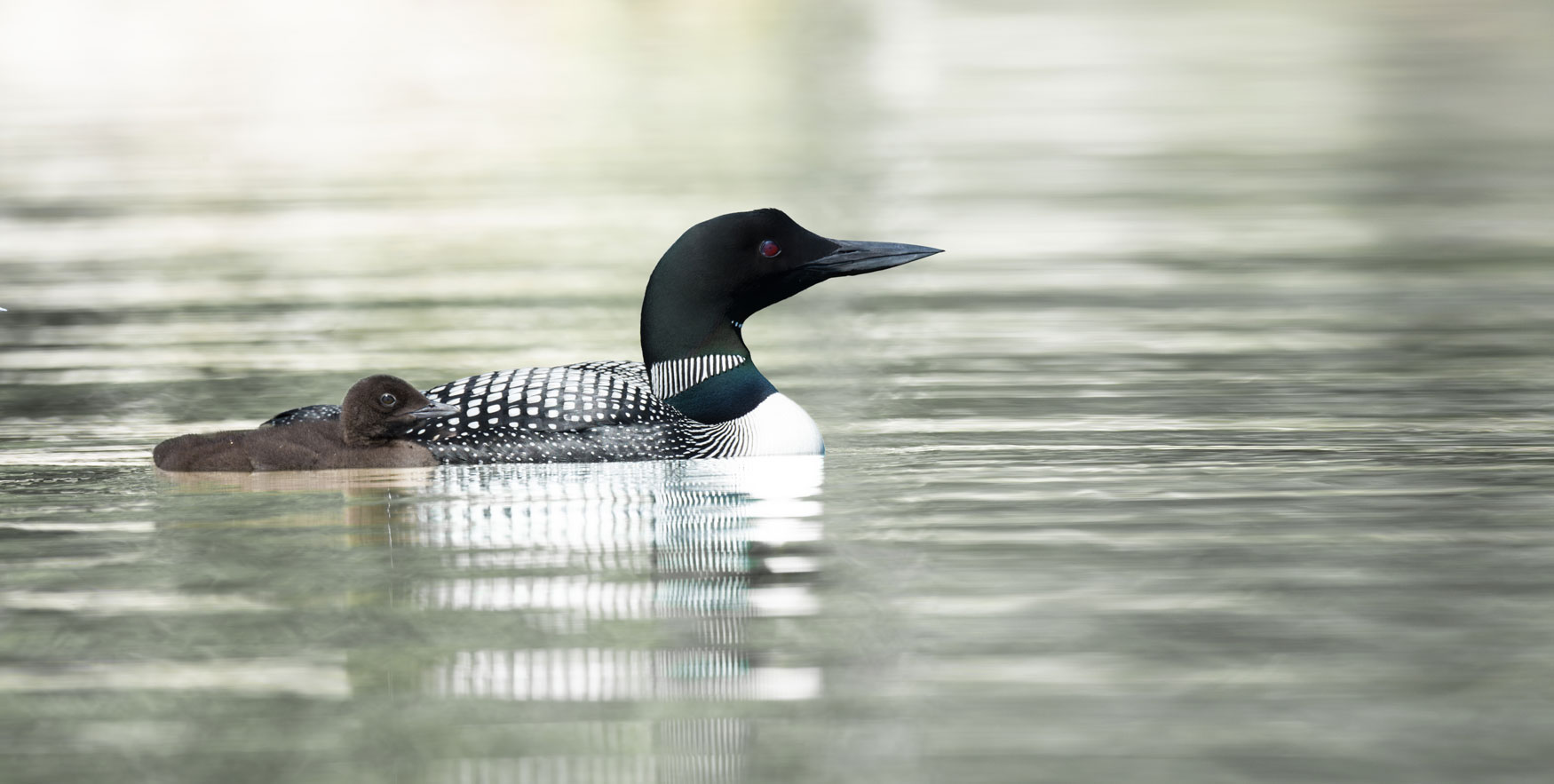
The common loon is synonymous with the tranquil lakes of the Laurentians. Its call provides the soundtrack for many films. For researchers, it also serves as an indicator of lake health, as it prefers clear, fish-rich waters for establishing its territory. Once established on a lake or in a large bay, adults generally remain loyal to their territory for many years and vigorously defend it against intruders.
According to the Canadian Loon Census, conducted jointly by BirdLife Canada and QuébecOiseaux, breeding success has reportedly declined by 1.4% per year since 1992. In fact, only the province of Québec shows a stable trend in the number of chicks produced per pair per year. Could the lack of sampled lakes explain this trend?
Not so fast! The rapid development of vacation resorts around the lakes could change the situation. Common loons nest in quiet areas of lakes and on islands, always near the water. Boats passing by can create waves that flood the nests or disturb the adults as they feed their young. The development of shorelines affects the natural habitats of fish and loons. Not to mention the use of lead fishing weights, which are toxic to common loons.
An avid birdwatcher, Nathalie Léonard asked herself the following question: “What impact does tourism have on the reproduction of common loons?” She discovered the “Engagement” program created by the Fonds de Recherche du Québec (FRQ), which allows members of the public to team up with university professors and researchers to answer questions that intrigue them.
The “Engagement” program allowed her to submit her question and find a researcher, Denis Réale, to help her answer it. Denis is a biology professor at the Université du Québec à Montréal (UQAM) and a specialist in animal behavior.
Together, they set up a participatory research project to answer her question.
This research project uses a citizen science approach to collect data on common loons and visitor traffic at vacation lakes in the Laurentians. This will allow us to compare the data with lakes in protected natural areas that are free of vacation development. The success of this project depends on the involvement of passionate volunteers. Help us cover as many lakes as possible by joining the team today.
© Claude Dubé
Is the common loon doing well in Quebec?
Researchers want to get to the bottom of it
- Portrait
- Situation
- So, everything's okay?
- The project
- To participate
The common loon is synonymous with the tranquil lakes of the Laurentians. Its call provides the soundtrack for many films. For researchers, it also serves as an indicator of lake health, as it prefers clear, fish-rich waters for establishing its territory. Once established on a lake or in a large bay, adults generally remain loyal to their territory for many years and vigorously defend it against intruders.
According to the Canadian Loon Census, conducted jointly by BirdLife Canada and QuébecOiseaux, breeding success has reportedly declined by 1.4% per year since 1992. In fact, only the province of Québec shows a stable trend in the number of chicks produced per pair per year. Could the lack of sampled lakes explain this trend?
Not so fast! The rapid development of vacation resorts around the lakes could change the situation. Common loons nest in quiet areas of lakes and on islands, always near the water. Boats passing by can create waves that flood the nests or disturb the adults as they feed their young. The development of shorelines affects the natural habitats of fish and loons. Not to mention the use of lead fishing weights, which are toxic to loons.
An avid birdwatcher, Nathalie Léonard asked herself the following question: “What impact does tourism have on the reproduction of loons?” She discovered the “Engagement” program created by the Fonds de Recherche du Québec (FRQ), which allows members of the public to team up with university professors and researchers to answer questions that intrigue them.
The “Engagement” program allowed her to submit her question and find a researcher, Denis Réale, to help her answer it. Denis is a biology professor at the Université du Québec à Montréal (UQAM) and a specialist in animal behavior.
Together, they set up a participatory research project to answer her question.
This research project uses a citizen science approach to collect data on loons and visitor traffic at vacation lakes in the Laurentians. This will allow us to compare the data with lakes in protected natural areas that are free of vacation development. The success of this project depends on the involvement of passionate volunteers. Help us cover as many lakes as possible by joining the team today.