
Natural History of common loons
- Phenology...
- Breeding site
- Food
- Behaviors
In the spring, the common loon arrives in April or May, shortly after the lake has “frozen over.” Males generally arrive before the females. As soon as pairs form or members of an existing pair reunite, they take the time to bond or reconnect, a process that can last several weeks, after which nest building begins, followed by egg laying.
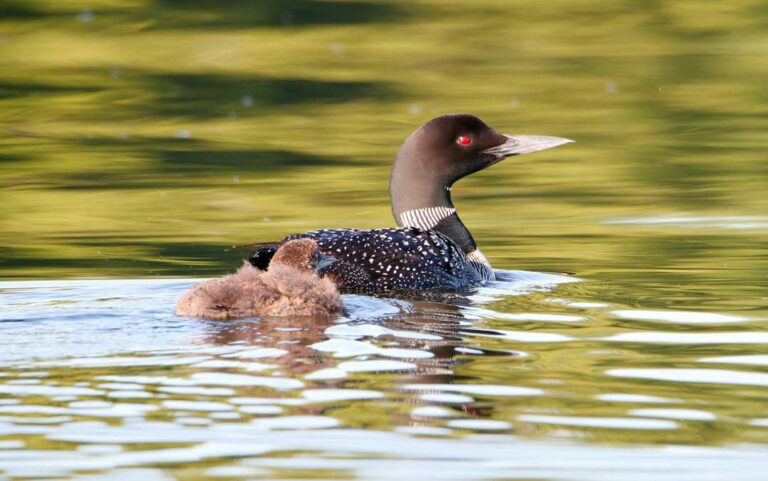
In the Laurentians, egg-laying begins in May or June. After an incubation period of about a month, the young leave the nest just a few hours after hatching. By late summer, on the large lakes that are home to many pairs, the birds gather. Then, they gradually begin their fall migration starting in September.
The nest is built on the ground, very close to the water, preferably on an island rather than on the shore. It is generally located far from populated areas and infrastructure, where the riparian vegetation is rich in species.
The common loon feeds on a wide variety of fish and certain crustaceans (e.g., crayfish), which it catches mainly in clear, shallow waters. It swallows most of its prey underwater, except for the largest fish—which can grow to over 12 inches—which it brings to the surface. Although rare, it sometimes carries its catch from one lake to another.
As highly territorial birds, common loons rarely allow another adult to enter their territory during the breeding season, especially early in the season (May). During this period, if you see two adults together, you can assume they are a pair unless they exhibit aggressive behavior (e.g., chasing each other rapidly, rising out of the water, or splashing).
Another way to determine if they are a pair is to keep track of where you’ve observed the adults; if you regularly see two loons in the same area, you can consider them a pair.
- Phenology...
- Breeding site
- Food
- Behaviors
In the spring, the common loon arrives in April or May, shortly after the lake has “frozen over.” Males generally arrive before the females. As soon as pairs form or members of an existing pair reunite, they take the time to bond or reconnect, a process that can last several weeks, after which nest building begins, followed by egg laying.
In the Laurentians, egg-laying begins in May or June. After an incubation period of about a month, the young leave the nest just a few hours after hatching. By late summer, on the large lakes that are home to many pairs, the birds gather. Then, they gradually begin their fall migration starting in September.
The nest is built on the ground, very close to the water, preferably on an island rather than on the shore. It is generally located far from populated areas and infrastructure, where the riparian vegetation is rich in species.
The common loon feeds on a wide variety of fish and certain crustaceans (e.g., crayfish), which it catches mainly in clear, shallow waters. It swallows most of its prey underwater, except for the largest fish—which can grow to over 12 inches—which it brings to the surface. Although rare, it sometimes carries its catch from one lake to another.
As highly territorial birds, loons rarely allow another adult to enter their territory during the breeding season, especially early in the season (May). During this period, if you see two adults together, you can assume they are a pair unless they exhibit aggressive behavior (e.g., chasing each other rapidly, rising out of the water, or splashing).
Another way to determine if they are a pair is to keep track of where you’ve observed the adults; if you regularly see two loons in the same area, you can consider them a pair.